
From the Archives
By: Rita Cook
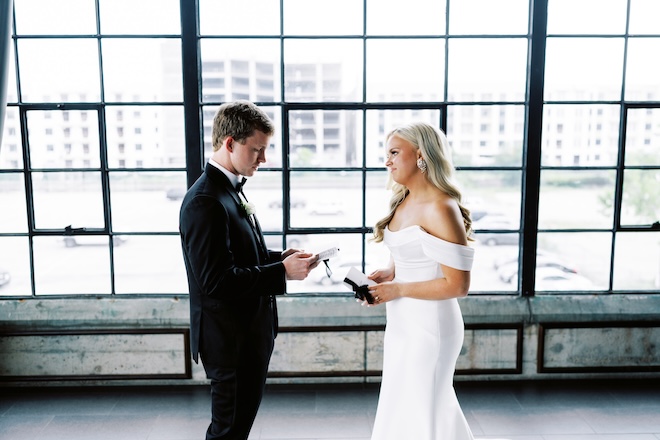
Webster’s dictionary defines the word vow as “a solemn promise by which a person is bound to an act.” When thinking about your own personal wedding vows, take the time to think about what this definition means to you.
A wedding vow’s wording can lay the groundwork for the future of a marriage. In its simplest terms, a wedding vow is the act of two people making a promise to one another of unconditional love (in sickness and in health) and with no conditions attached (for richer or for poorer). In most Western wedding ceremonies, it is common for the couple to repeat vows of love and support, even going so far as to say, “till death do us part.” However, this is not a tradition that is practiced around the world, as many cultures have entirely different or, at the very least, additional ways of expressing love and commitment to one another.
Many of today’s wedding couples view traditional vows as too generic. These couples are intent upon personalizing their vows and establishing their own unique wedding traditions.
With that in mind, brides and grooms are choosing to significantly edit what our mothers and grandmothers would have thought were sacred vows not meant to be altered. Indeed, more couples are choosing to write their own wedding vows in a genuine effort to express the real feelings they share for one another.
While many people believe that the tradition of the wedding vow originally comes from the bible, there actually is no biblical passage that states that wedding vows are mandatory. In fact, the reading of wedding vows in a marriage ceremony has more cultural significance than anything else, and with cultural traditions come a variety of differences from country to country.
In modern times, wedding vows are legally required even if only in a civil ceremony. Keep in mind that even when officiants at wedding ceremonies do read vows aloud, these vows almost never come from the bible. The officiant will usually read a book of vows that has been edited as needed for the occasion. And while it is true that bible verses and other religious scriptures from various faiths often are incorporated into a wedding ceremony, these passages are always added by choice.
Most religions have specific traditions surrounding the marriage ceremony and the wedding vows. There are many types of wedding vows, from ethnic vows to personalized wedding vows to the oft-heard vows we all know and love.
In fact, there are three categories that are consistently used for wedding vows the world over. These include the traditional vow ending in “I do,” a more personalized form of the standard vows, and completely customized wedding vows where the bride and groom write their own words to share with one another and those in attendance.
If you are thinking about crafting customized vows, you will want a vow style that fits your personality. If you are reserved, don’t do something outrageous, as you will more than likely regret it later. Instead, consider incorporating ethnic elements, or choose a favorite poem or song.
If you aren’t the type to write your own vows, there is nothing wrong with going with traditional language. The most commonly used wedding vows in Christian ceremonies actually come from the Episcopal Church’s 1662 Book of Common Prayer. Almost everyone has heard the traditional pledge: “I (bride’s name), take the (husband’s name) to be my wedded husband, to have and to hold from this day forward, for better or for worse, for richer or for poorer, in sickness and in health, to love and cherish, till death do us part.”
In Jewish culture, marriage is regarded as a sacred union that allows the Jewish race to continue. And while you may not often hear the words “I do” at a traditional Jewish wedding, many Jewish couples are choosing to exchange personal wedding vows in either Hebrew or English. When exchanging vows, if using a language other than English, it is a good idea to provide handouts that explain to guests what is being said.
Traditional muslim marriages that are arranged by the bride and groom’s parents often feature vows that acknowledge the parents’ involvement. Since it is a tenet of the Islamic religion that the foundation of society is based on marriage, the traditional Muslim ceremony will have an officiant discussing with the bride and groom what marriage means. Afterwards, the bride and groom give their consent, then the traditional exchange begins. The typical wording includes the bride saying, “I (name), offer you myself in marriage in accordance with the instructions of the Holy Koran and the Holy Prophet, peace and blessing be upon him. I pledge, in honesty and with sincerity, to be your obedient and faithful wife.” The groom then says, “I pledge, in honesty and with sincerity, to be for you a faithful and helpful husband.” The Koran goes over the importance of marriage for all Muslims and says, “And among His signs is this, that He created for your mates from among yourselves, that you may dwell in tranquility with them, and He has put love and mercy between your hearts.”
Both Hindu and Buddhist wedding ceremonies incorporate vows as well. The Hindu vow ritual is called saptapadi, meaning the seven steps. In this particular ceremony, the couple holds hands and takes seven steps around a fire. As each step is taken, the bride, the groom, or the officiant puts forward seven special blessings for the marriage. One example of a blessing is “Let us take this first step, vowing to keep a pure household, avoiding things that might harm us.” The seventh step might conclude, “Let us take this seventh step to vow that we will always remain true companions and lifelong partners.”
Buddhist wedding ceremonies are considered more secular since there is no particular religious implication. In fact, there is not one traditional Buddhist ceremony for a wedding, but many rituals, such as the lighting of incense and offerings to Buddha, are always a part of the exchanging of the vows. In a Buddhist ceremony, vows from the Buddhist guide for the domestic and social life of a layman, called the Sigalovada Sutta, are usually used.
Vows that are most often used in secular weddings center more on the couple’s faith in one another. However, it is not uncommon for some religious vows to be a part of the ceremony. A secular wedding vow may go something like this: “I (name) take you (name) to be my (husband/wife). I promise to be true to you and only you, to love and trust and honor you. I will share your sorrows, be a claiming presence in your life for both the good and the bad.” Many secular weddings include vows from the Episcopal Church’s Book of Common Prayer, and while the ceremony may offer traditional rituals as in religious ceremonies, bride and grooms usually prefer the freedom to do as they would like when it comes to the ceremony and the vows.
One more thing to keep in mind, whether you plan on writing the vows yourself or plan to borrow from religious tradition, is that your church often will have a say in what words you can exchange, and may not allow you to change the wording of traditional religious vows. Be sure to ask your clergy for his or her thoughts on this matter before you begin to write your own vows, so that your ceremony expresses as much respect for your house of worship as you and your spouse do for each other.
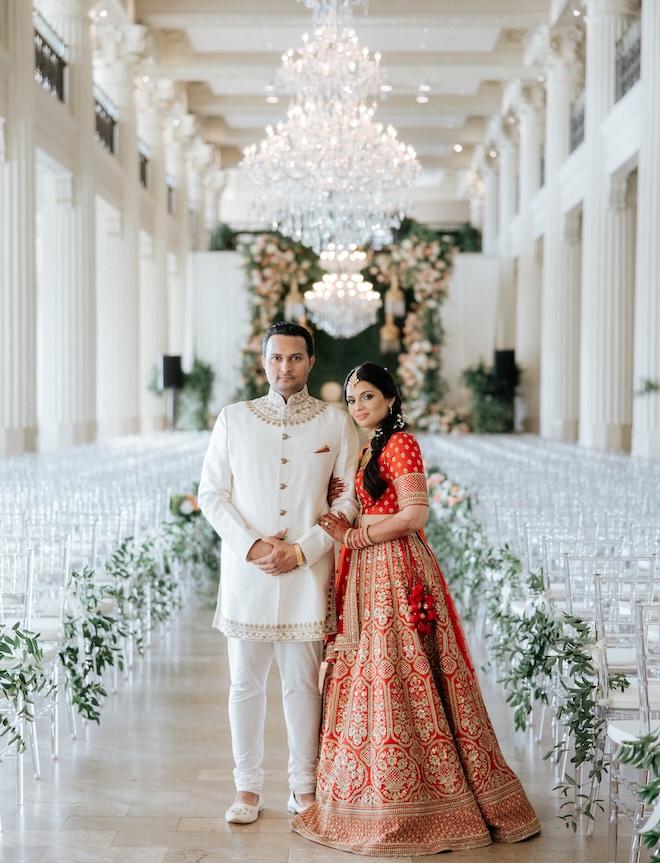
“How To Write Wedding Vows That Truly Reflect Your Love” Spotlight WiH Partners- Venue: The Post Oak Hotel at Uptown Houston | The Astorian | The Houstonian Hotel, Club and Spa | Grand Galvez | Corinthian Houston | Cake: Susie’s Cakes | Registry + Stationery: Bering’s | Florals + Decor: Plants N’ Petals | Rehearsal Dinner: Ouisie’s Table | CVB: Visit Galveston
Contributing Photographers- Wandering Woo Photography / Katy Grant Photography / Marco Wang Photography / Shaimaa Photography / Daniel Colvin Photography
Related Posts
 “Survivor” Contestant Weds with a Black, Gold and White Wedding
 A Blush, White & Red Indian-Fusion Wedding at The Bell Tower on 34th
 Nicole Johanna Photography Captures an Intimate Ballroom Wedding
 Real Houston Couples Reveal Their Best Wedding Advice
 An Art Nouveau Wedding at the Historic AvantGarden
 An Enchanting Fusion Wedding Blending American & Bengali Traditions